Research and standards
Published methods, each with a DOI and a date
The frameworks we apply in client work are written by our principal, Panos (Panagiotis) Sampokilis, and deposited on Zenodo. Anyone can read them, cite them and check when they were published. The research began in 2016 with SASF, continued with MPT in 2017 and KAI in 2019, and is ongoing. It was kept in a private repository until the first Zenodo records in 2025.
ORCID 0009-0004-3409-5105
Frameworks
Four pieces of one approach: AI you can audit
Since 2017, private repository. First Zenodo record 28 Nov 2025
Midpoint Projection Theory (MPT)
Projects a representation onto the average of its symmetry orbit, so that redundant symmetric variants collapse into one canonical form. We use it to compress and stabilise representations before inference.
Since 2019, private repository. First Zenodo record 9 Dec 2025
KAI: Knowledge Absolute Index
Research began in 2019. First published in 2025 as KAI Spaces, a geometric model of knowledge. In 2026 it became an index that scores what an AI pipeline has demonstrably shown against explicit reference contracts, with gates that fail a system when evidence is missing.
Since 2016, private repository. First Zenodo record in preparation
Symmetry-Aware Sequence Flow (SASF)
Requires every intermediate step of a multi-step process to be a valid state. An interrupted firmware update, training run or agent dialogue then stops safely instead of needing a rollback.
First Zenodo record 5 Dec 2025
Entity Portfolio Optimization (EPO)
Builds and maintains a graph of entities and relations from documents before retrieval, so that a retrieval pipeline works on consistent entities instead of raw text fragments.
In use outside our own work: the KAI and SASF metrics are the independent geometric validation in QuantoLiSense, an Innovate UK project on quantum-informed LiDAR sensing (project 10179826).
Applied projects
Where the methods are put to work
Oct 2025
Browser-based ECU calibration viewer
Proposal and work plan for a web tool that opens engine calibration files, shows fuel, ignition and boost maps in 2D and 3D, and exports with a verified checksum. One map model covers several ECU families, files are parsed in the browser so they stay with their owner, and the tool does no flashing.
Proposal and work breakdown on file.
Nov 2025 to Jan 2026
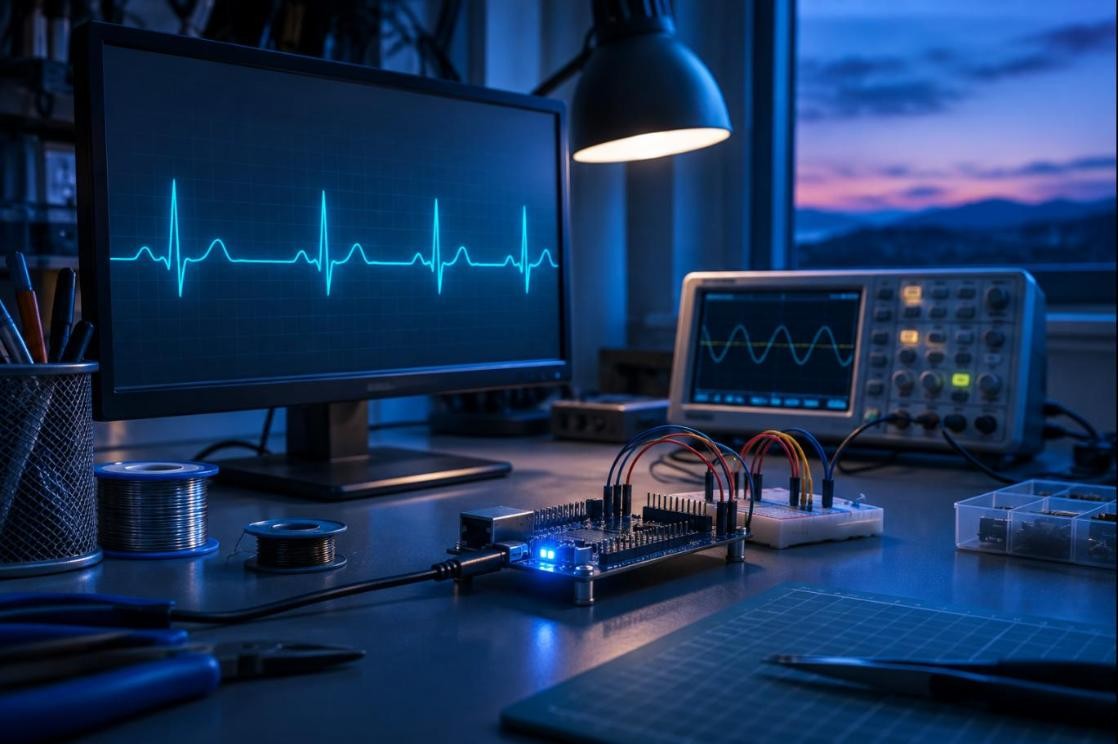
Predicting cardiac pauses in tilt-table ECG
A pipeline that reads a single-lead ECG during a tilt-table test and warns before a cardiac pause: filtering, R-peak detection, alignment with the test phases and prediction over short windows. It is trained first on a synthetic tilt-test dataset built for the purpose.
Research in progress. Project outline, dataset generator and pipeline specification on file.
Jan to Feb 2026
ECG early warning for syncope risk
Detection of abnormal beats in the ECG as an early-warning proxy for syncope risk, built on Google Cloud, and a demonstrator in which cooperating agents apply the KAI method to predict cardio-inhibitory syncope early.
Reports and demonstrator design on file. Biosignals course report, University of West Attica.
Feb 2026
Closed-loop adaptive interaction with a social robot
A two-layer control design for robot-assisted learning: one layer assesses the learner's state, the other adapts the flow of the session and can explain why. It is robot-agnostic and prototyped on an emulator of the NAO robot at the edge. Related work applies the same closed loop to support for autism assessment.
Design and proof of concept. Paper drafts, February 2026.
Feb 2026
LiDAR reconstruction for emergency braking in fog
The automotive use case of QuantoLiSense: whether quantum-informed reconstruction of ordinary LiDAR data keeps object structure intact in fog, so that automatic emergency braking triggers reliably. Cognity contributes the reconstruction layer, with SASF and KAI as the structural and geometric checks. It is a software layer and not LiDAR hardware.
Use case and paper outline, February 2026.
April 2026
DNA sequence analysis curriculum
Six notebooks that take a physics graduate from first Python to a working sequence analyser: reading FASTA files, finding single-nucleotide variants and their effect on the protein, and classifying sequences from k-mer features with machine learning.
Teaching material on synthetic data, written to mentor an MSc candidate.
June 2026
Emotica: facial-expression flow across a course
A camera application that detects faces, classifies expressions, smooths them over time and reports how attention moves through a lesson, segment by segment. It runs on CPU, for edge devices, and ships with a responsible-use policy.
MSc project, University of West Attica, submitted 17 June 2026.
May to June 2026
Turbocharged engine state classification
Driving logs from OBD-II and VCDS are turned into telemetry images, including maps of expected against logged boost, and a convolutional network classifies each window as idle, cruise, boost spool, full boost or boost deviation.
MSc project, University of West Attica. Eight notebook iterations and a prepared dataset on file.
Sep 2026
Dyno chart anomaly classification
A vision model that reads a dynamometer chart (torque, power, boost, air-fuel ratio, exhaust temperature) and names the anomaly it shows. It is the perception module of a cloud engine-tuning platform, with a sequence model on the raw telemetry as its reference. The service rejects charts it was not trained for and flags low-confidence answers for review.
MSc project, University of West Attica. Synthetic datasets of 300 and 1,200 charts.
2026
An adaptive, learning-based standalone ECU
Groundwork for an engine controller that learns: ignition, fuel, boost and an adaptive first run, with traction control and drift control using ABS and injection signals, AWD coupling and edge AI on an NVIDIA Jetson. The test cars are an Audi TT 8N quattro and a supercharged MG F 1.8 MPi. The ECU-1 prototype board is rendered. It builds on hands-on work since 2020 with calibration tools, standalone ECU wiring and drive-by-wire integration on the Audi, on earlier work with Haldex AWD controllers and on motorsport electronics since 1998.
Research and prototype.
Publications on Zenodo
12 records, newest first
| Date | Title | Type | DOI |
|---|---|---|---|
| 8 Nov 2026 | Entity Conditioned Opportunity Intelligence through an Evolving Knowledge Manifold | Preprint | 10.5281/zenodo.24060577 |
| 13 Oct 2026 | AI Representation: Knowledge Absolute Index | Preprint | 10.5281/zenodo.23337659 |
| 1 Oct 2026 | Securing the AI Input Channel. Manifesto v1.0 | Preprint | 10.5281/zenodo.23090364 |
| 8 Sep 2026 | AI Act Requirement-to-Work-Item Gap Mapping. StandICT.eu 2029 fellowship 2029-02-1773 | Report | 10.5281/zenodo.22666868 |
| 13 Dec 2025 | Digital Media Evidence Handling Policy for Law Firms. An End-to-End GDPR-Aligned Process | Preprint | 10.5281/zenodo.17921117 |
| 13 Dec 2025 | Gap Analysis on the Handling and Circulation of Digital Media Evidence in Greek Judicial Proceedings | Preprint | 10.5281/zenodo.17920607 |
| 9 Dec 2025 | KAI Spaces: Foundations of a Projectional Manifold Theory. Chapters 1 to 3 | Working paper | Under revision |
| 5 Dec 2025 | Entity Portfolio Optimization (EPO), a Reinforcement-Driven Symbolic Knowledge Extraction Framework | Preprint | 10.5281/zenodo.17831584 |
| 5 Dec 2025 | Comparison of EPO-Proposal Framework and Docling System: A Semantic-First vs Token-First Approach to AI Document Processing | Technical note | Under revision |
| 5 Dec 2025 | Latent Symmetry Folding in Variational Autoencoders: An Application of Midpoint Projection Theory. With Athanasios Karantjias | Article | 10.5281/zenodo.17831263 |
| 5 Dec 2025 | Midpoint Projection Theory (MPT) | Working paper | Under revision |
| 28 Nov 2025 | Θεώρημα Προβολής Μέσου Σημείου. Midpoint Projection Theorem, Greek-language record under Cognity Computing & Consulting SRL | Listed as patent [APPLICATION NO.] | 10.5281/zenodo.17750781 |
Conference paper: Bias Auditing in Transformers, CoDIT 2025. Consortium paper on QuantoLiSense in preparation.
Standards
We help write the standards we implement
Clients in regulated sectors need to know what a harmonised standard will require before it is published. We contribute to the drafting, so our designs anticipate it.
Related sites
Research profile of our principal.
Portfolio, products and research archive.
Local-first framework for efficient AI.
Compliance tool for NIS2, GDPR, the AI Act and the CRA.